
Get a selfie of your best customer.

ID-100184512

Stock images at FreeDigitalPhotos.net

Would you recognize your best customers? Do you know what they look like? Why not have them send in a selfie?

Okay, scratch the selfie idea. But even if they don’t send you a selfie, you should recognize their attributes and their value. The top 20% of your customers often represent 80% of your business. By recognizing who they are and what is important to them, you can strive to attract even more customers who look like your best customers. Here are a few ways to do it:

1. Clone your best customers. When choosing ad demographics or lists, choose segments that most closely match the demographics, interests and behaviors of your best customers. That way you can create “clones” that look like them.

2. Tailor content to your best customers. Find out what kinds of content your best customers like to read or view. Hit on the topics and types of content that they respond to most. This will also attract similar prospects.

3. Encourage other customers to be like best customers. Look at the behaviors and transaction frequency of your best customers. Identify customers who don’t quite behave like your best customers and feed them offers and incentives to act like your best customers. Use trigger dates to get them to visit or shop as often as your best customers.

4. Listen to your best customers. Do you survey your best customers? In addition to tracking their behaviors, it’s always a good idea to find out what they want by simply asking them. Find out exactly what their preferences are. Find out whether they are satisfied with your products or services. Also find out if they would recommend you to their friends.

5. Think like your best customers. Don’t forget to put yourself in your customer’s shoes. Try to figure out what you would want if you were the customer. Think critically. Try to predict what your customers will be asking for before they ask.

Email frequency: How often should you hit their inbox?

ID-100178869

Stuart Miles/FreeDigitalPhotos.net

It’s a simple question: “How often should I send my marketing emails?”

Do a quick Internet search and you’ll see a lot of simple answers—once a week, once a month, etc.

Problem is, it’s not a simple answer. The first thing you need to ask is whether these emails are going to prospects, leads or customers. You’ll want a different communication strategy for each.

For prospects, you can certainly hit them multiple times over weeks or months. In fact, in this article, tEkk3 explains why frequency matters more than reach. In other words, mailing the same prospects multiple times can be more beneficial than mailing one larger mailing list once. But that doesn’t mean you can mail the same list forever. As pointed out in this MailChimp article, frequency and engagement are negatively correlated.

Now let’s think about leads. Someone has responded to you and provided their email and wants to know more. Perfect. Because this person has just asked you for more information, they are expecting it. In fact, you may have already informed them they you would be sending several follow-up emails at the time they opted in. So for this type of contact, communicating frequently in the short-term is okay, and expected.

There are actually many forms of lead nurturing, from a “drip campaign” to a “lifecycle campaign.” Marketo has a good Marketing Cheat Sheet about lead nurturing that goes into more detail on definitions, tracks and strategies. Take a look.

Depending on the type of product or service you offer, you may set up a lead nurturing track that communicates every few hours, days or weeks. You may have a 30-day nurture strategy, or a 180-day nurture strategy. Remember, with lead nurturing you can usually email frequently, especially in the first few days or weeks after they opt in.

Finally, you have your current customers. With this group, you may also have individual communication strategies for each segment of customers (new, active, win back, etc.). But overall, you’ll want to keep in contact with them as frequently as they would like you to. Once or twice a month may be appropriate.

Benchmark also has some good suggestions on how often to send email, as well as when to send it. Once every week or two is the most common. For high frequency emailers, your customers may be okay with two or three emails a week.

Remember: Keep your type of recipient in mind, build a contact strategy for each type, and then be consistent.

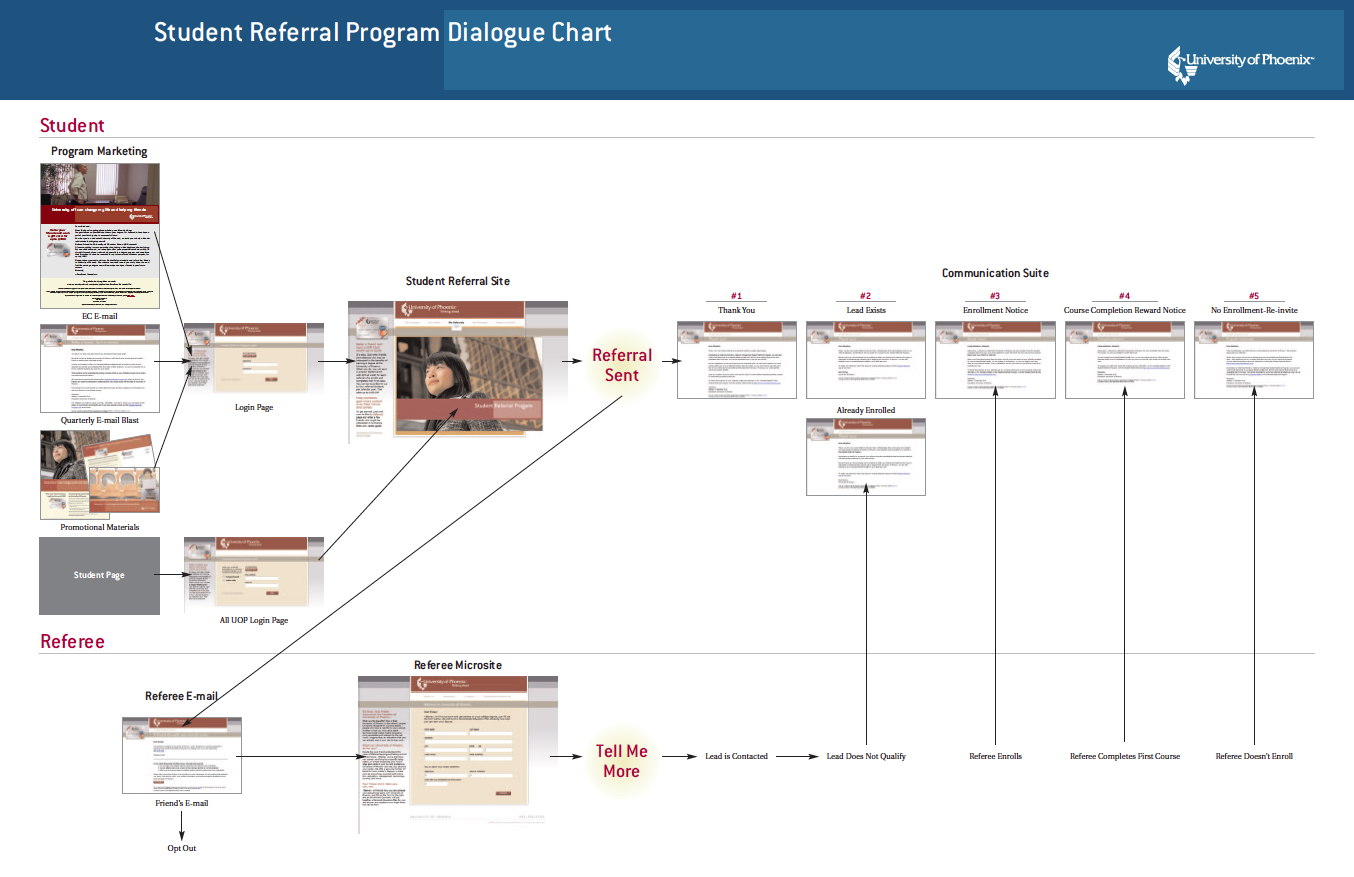
Building University of Phoenix leads through a student referral program.

University of Phoenix was looking for a way to build more referrals from current students. To achieve this, Rastar Digital Marketing was hired to build a program that captured referrals, tracked referrals through to enrollment and registration, then rewarded students.

I was the communication strategist and lead copywriter on the project. I wrote content for a microsite in which students could become educated about the program, enroll in the program and then submit referrals. Once referrals were submitted, they went into the University of Phoenix database to ensure the lead did not already exist. Once validated, an email confirming the submission was sent back to the student.

Due to privacy rules, only a limited amount of information could be shared with the student as far as the progress of their referrals. Once students hit each milestone, a status email was triggered. The students were rewarded with pre-paid gift cards for each referral that enrolled, registered and began their first class.

The success of the project was amazing. To get the program off the ground, links to the new student referral site were placed on the University of Phoenix student site. Within days, thousands of referrals started to pour in. The number of student referrals submitted quickly moved it up the ladder to the lowest cost of new leads for the highest quality of lead. The program ran for three years until regulations surrounding student referrals changed.

University of Phoenix Referral Program

Email Jeff